
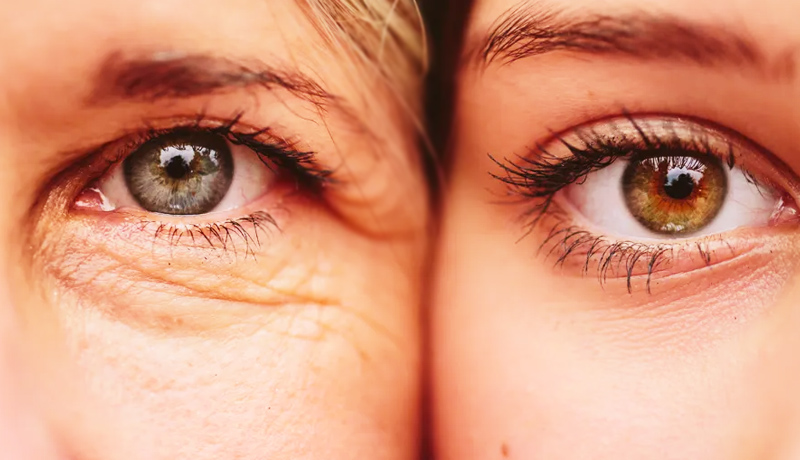
Although we love our parents very much, the comment “You’re already like your parents!” is not heard gladly. Why can we be so annoyed with this comment? And is it true that we really do become just like our parents?
Sure, visually alone we are very similar to our parents. Mum’s nose and brown curls, plus we have inherited our father’s facial expressions and laugh. But not only that. At some point around 30, we suddenly realize that we, who used to want to do everything so differently from our parents, are behaving more and more like our parents.
Suddenly you find yourself saying the same things to your boyfriend as your mother used to. “Don’t drink from the bottle.” “Turn off the lights when you leave.” You clean up after your partner, care for them and worry about them and get upset about it at the same time.
When exactly did this happen? Wasn’t one just the rebellious teenager who always found these very phrases from one’s parents so incredibly stupid? Didn’t you want to be different? Deeply relaxed and easy-going with everything? I certainly didn’t want to mutate to the point where I start teaching my boyfriend that an aired shower curtain smells less musty than a crumpled one.
Nevertheless, it happens. At the latest, anyone who has children of their own has to admit that they are following in their parents’ footsteps quite unerringly. You admonish your own child not to eat so many sweets and at the same time you think to yourself: “That sounds familiar…”
3 factors shape us in particular
It is hardly surprising that we resemble our parents or guardians in our behavior. On the one hand, of course, because we resemble them genetically. Scientific studies have shown that our genes have a major influence on the development of our personality.
But there is also the environment in which we grow up, i.e. our family or other guardians. The environment in which we grow up also has a decisive influence on our behavior. Just as our children learn their behavior from us, our parents were also our role models. No one has shaped us as much as our mother and father. “This concerns attitudes, automatic behaviors, but also how we deal with feelings and closeness,” says psychotherapist Dr Silvia Dirnberger-Puchner, who has written a book on the subject.
Nevertheless, there is a third influencing factor, namely the contacts that shape us outside the family, for example friends, role models such as teachers or coaches, or good or bad experiences that we had to make and that have shaped us.
Nevertheless, our parents are an enormously formative factor for every child, both genetically and through their role model function, which we can hardly escape. And whether we like it or not, this is something we notice to a greater or lesser extent in the course of our lives.
A copy of the mother ?
As long as we are younger and our lives are fundamentally different from those of ‘adults’, we don’t really notice these parallels. However, as soon as we get older and our lives are no longer so strikingly different from those of our parents, even with a steady relationship, a job and children of our own, we notice: We have adopted our mother’s security thinking, also have a building society contract and are thinking about buying a house.
In a survey by the English online portal Netmums, the vast majority of women said that they had become more and more like their own mother from about the age of 32. Tics, rituals or certain phrases – there was hardly a woman who couldn’t think of anything in common with her own mother.
It’s just stupid that we don’t just inherit the positive qualities from our parents, but also the bad ones. Anyone who has always been bothered by the fact that their parents have no real culture of conflict and sweep many problems under the carpet must be aware that their behavior in conflicts has also been shaped by their parents. After all, we react intuitively and without much thought in a dispute, and then we usually automatically take the path that we have been taught half our lives.
The brain, a creature of habit
Our brain, the old creature of habit, is to blame. It makes sure that we do certain things automatically without thinking about it. Simply because we have ‘always done it that way’. Living together with our parents, we are shown patterns. We store these patterns and in this way patterns and structures are formed in our brain, which we use as a guide in life and which determine our actions. “Stored in the nerve cells, regular paths are formed over the years through recurring patterns of action,” explains Dr. Dirnberger-Puchner.
But don’t worry. We do not inevitably become a mini version of our mother. Dr Dirnberger-Puchner says: “Every person is unique and incredibly rich in abilities.” In her book, she explains how to understand and accept your parental roots, but also actively change your life at the same time.
If you want to do things better or differently than your parents, you should start with the most important point, says the expert: “We first have to understand why we react the way we do. Understanding the genesis is the most important thing.”
Step two: On the one hand, one should recognize and value the inherited behaviors, but also consider whether there are also some that are more of a hindrance to one’s own life. Because you can certainly try to change what doesn’t fit. And you can do this by considering alternative courses of action. For example, if you never learned to say ‘no’ at home, and therefore always get the short end of the stick at work, you should work on getting rid of your habitual behavior patterns.
Of course, behavior patterns that the brain has once stored cannot be changed overnight. It can sometimes take years. But let’s be serious: Fortunately, our mother and father also have many good qualities. That’s why you should honestly ask yourself, “Is it really so bad if I become a bit like my mother?”